Our mission is to create safe, supportive communities so that no child, teen, or family has to grieve alone
The Children’s Room is a nonprofit dedicated to supporting children, teens, and families in Massachusetts who are grieving. We provide free-of-charge grief support services, programs for schools and community organizations, and education and training for professionals.

Values
Communication. Connection. Empowerment. Honesty. Intention. Respect.
The Children’s Room is grounded in these core values, which guide how we show up for children, teens, and families who are grieving, how we work with one another, and how we partner with our community.
Vision
The Children’s Room was founded on the belief that every child, teen, and family grieving a death deserves a safe, supportive, and understanding environment.
We seek to broaden our impact by expanding access to grief support services, strengthening educational outreach, and deepening partnerships within our communities.
We aspire to be a leader in the field of childhood bereavement and a catalyst for transforming how grief is understood, acknowledged, and supported.
We envision a world where loss is met with understanding and patience, allowing grief to be integrated into life in ways that foster compassion, connection, and hope.
History
The Children’s Room was born out of Hospice West in Waltham, Massachusetts, where a group of caregivers saw firsthand that children and teens often had few places to turn after the death of someone important in their lives. Families were receiving support, but children’s grief was frequently overlooked or misunderstood.
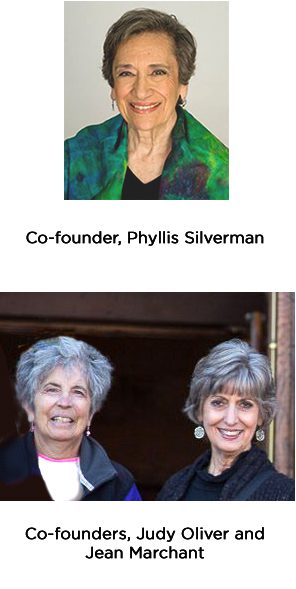
In 1993, inspired by this unmet need, a group of caregivers and volunteers—including co-founders Jean Marchant, Judy Oliver, and Phyllis Silverman—came together to create a space dedicated to grieving children and their families. That same year, they received training from the Dougy Center for Grieving Children, helping shape an approach that centered children within the context of their families and communities.
The name The Children’s Room reflects both the organization’s beginnings—services were initially held in a single room at Hospice West—and its larger vision: to create a welcoming place where children, teens, and families could grieve openly, be understood, and feel less alone.
In 1995, work began to establish The Children’s Room as an independent nonprofit organization, and in April 1996 it became a 501(c)(3). By 1999, the organization had moved to a church basement, where eight trained volunteers supported seven families. Within a year, the number of people served had quadrupled. In 2004, The Children’s Room opened its permanent home in a Victorian house in Arlington, Massachusetts, which was later renovated in 2013 to create additional space for programs.
The organization’s philosophy has been shaped by both lived experience and research. Co-founder Phyllis Silverman’s work on the Harvard Medical School/Massachusetts General Hospital Child Bereavement Study helped advance the concept of continuing bonds—the understanding that children maintain meaningful connections with people who have died—which remains central to The Children’s Room’s approach to bereavement support.
Today, The Children’s Room serves more than 4,000 children, teens, and families each year through center-based, school-based, and community programs. Every service is provided completely free of charge. The Children’s Room is funded through the generosity of individual donors, foundations, corporations, and community partners who make it possible for children, teens, and families who are grieving to receive support without financial barriers at a time when the death of a family member can also bring significant economic challenges.
What began as a grassroots effort in a single room has grown into Massachusetts’ leading independent nonprofit child bereavement center, supporting children, teens, and families who are grieving across eastern Massachusetts.