Grief Through a Hispanic and Latino Lens: Why Culture Matters in Bereavement Support
When we think about grief, it’s easy to focus on the emotions that often accompany it—sadness, anger, guilt, confusion, or longing. While these experiences can be universal, the way we understand, express, and respond to grief is deeply influenced by culture.

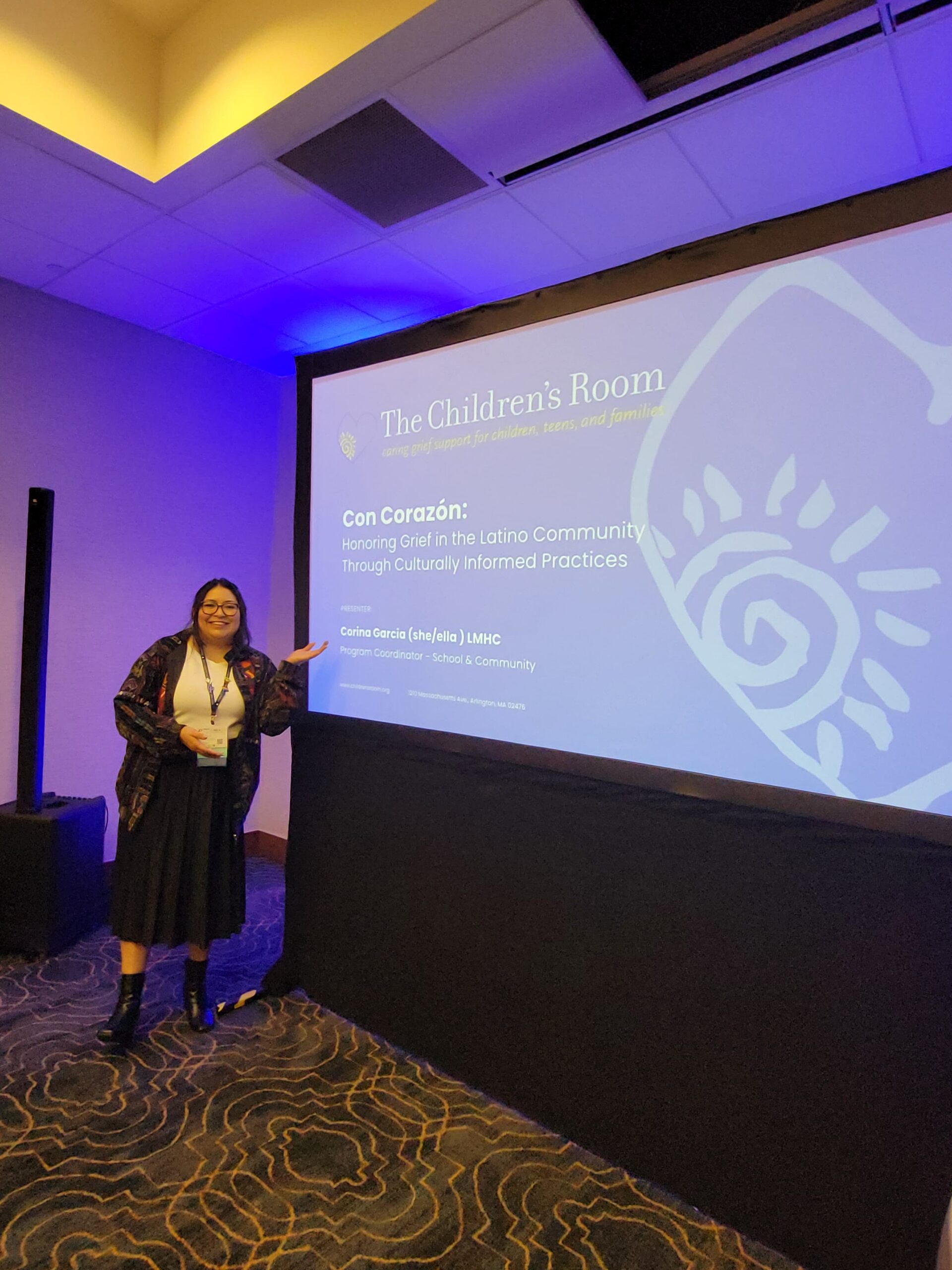
At this year’s National Alliance for Children’s Grief Symposium, The Children’s Room’s Program Coordinator, Corina Garcia- Reyes, presented Con Corazón: Honoring Grief in the Latino Community Through Culturally Informed Practices. Her presentation explored how culture shapes the grieving process and why cultural humility is essential when supporting children, teens, and families after a death.
Understanding culture isn’t about memorizing traditions or learning a checklist of customs. It’s about recognizing that every family brings its own beliefs, language, history, and ways of making meaning after loss. By approaching grief with curiosity and respect, we create space for every family’s experience to be seen and honored.
There is no single Hispanic or Latino experience
One of the biggest misconceptions about Hispanic and Latino communities is that they share a single culture. In reality, these communities are incredibly diverse.
Families may share a language, but their traditions, beliefs about death, mourning rituals, and expressions of grief often differ depending on their country of origin, region, family history, or personal experiences. Even the words people use to describe grief can vary from one community to another.
Recognizing this diversity reminds us that culturally informed support begins by listening rather than assuming. Every grieving family is the expert on their own experience.
Culture teaches us how to grieve
Long before we experience the death of someone important in our lives, culture begins teaching us what grief looks like.
It influences how we talk about death, whether emotions are openly expressed or quietly held, the rituals we practice after someone dies, and how we remember the people we love. It shapes who gathers around us, what support looks like, and how communities come together during times of loss.
These lessons are passed from generation to generation through family traditions, faith, community, language, and lived experience. They become part of how we understand grief long before we have words to describe it.
Family, community, spirituality, and remembrance often work together to provide a network of support. Whether through shared meals, religious traditions, storytelling, memorial rituals, or simply being present with one another, these practices remind grieving children and families that they do not have to carry their grief alone.

Why language matters
Language is more than translation—it shapes how we understand ourselves and communicate our most vulnerable experiences.
Corina notes that there is a common misconception that Spanish “has no word for grief”. In reality, Spanish includes rich and distinct vocabulary for different aspects of bereavement. Duelo refers to the internal grieving process, while luto describes the outward experience or state of mourning.
Many Hispanic and Latino communities also use words such as pena, pesar, or mal de los nervios to describe the emotional and physical realities of grief. While these words may have English equivalents, they often carry cultural meanings that don’t translate neatly.
Understanding grief through a cultural lens means paying attention not only to the words people use, but also to the meanings those words carry within their community.
Cultural humility matters more than cultural expertise
Providing culturally informed grief support isn’t about knowing everything about every culture. It’s about approaching each family with humility.
That begins with recognizing our own assumptions and understanding that the person sitting across from us is the expert on their own lived experience.
For professionals, this means remaining curious, asking thoughtful questions, and continuing to learn about the communities they serve. It also means recognizing that empathy, active listening, emotional validation, and creating safe spaces are skills that transcend cultural differences.
Rather than expecting grieving families to educate us, we can take responsibility for expanding our own understanding through ongoing learning, reflection, and meaningful engagement with diverse communities.
“Culture teaches us how to grieve because we are an active part of it.”
Meeting families where they are
Every family’s grief journey is unique. While no two experiences are the same, culture provides an important context for understanding how children, teens, and caregivers experience loss and seek support.
When we approach grief with openness, humility, and respect for cultural differences, we move beyond assumptions and create spaces where families feel truly seen. That doesn’t require having every answer. It begins with listening, honoring each family’s story, and walking alongside them with compassion.
Because ultimately, culturally informed grief support is not about treating people differently—it’s about recognizing and honoring the experiences that make each family’s journey through grief uniquely their own.